Teens, it’s easy to think the things that happen in our lifetimes have never happened before…that the events we experience personally or collectively are ours alone, totally unique to our time, and hazardously unmapped. While it’s true that names, dates, and details change, several Young Adult nonfiction books I’ve read lately have convinced me of another weird truth: so many current events are iterations of things from the past. When you peek behind the 21st century costumes, you sometimes find a lot that looks uncannily familiar.
 Before we jump into this week’s titles, I encourage you to talk to your parents about the books you read to decide what may be a good fit for you. I understand and honor that not every book is for every reader, and recognize how important it is for you and your family to make informed decisions about all the media you consume, including library books. With that, let’s get into it!
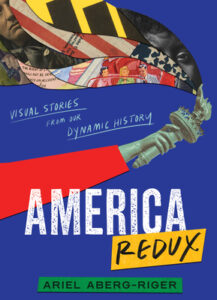
“America Redux: Visual Stories from Our Dynamic History” by Ariel Aberg-Riger is nothing like your history textbook. To tell you the truth, it’s unlike any book I’ve seen before. It approaches major topics in American history from a non-linear standpoint, one that explores the idea that time is cyclical, “a continual, ever-evolving relationship, not a series of isolated, fixed points on a line.”
What starts as a mind-bending premise (but one that is rooted in Native American, African, Chinese, Indian, Celtic, and Mayan philosophies), reveals that there are dots to be connected in American history. Aberg-Riger does this through visual storytelling; she uses a series of riveting collaged illustrations—that include historical photos, documents, maps, and hand-lettered text—to dunk you into an unblinking look at American history, suggesting connections you may not have previously considered.
This can’t be sugar-coated…many of the events the author explores are emotionally difficult to process. But looking at them through the author’s eyes did not leave me in despair. They actually gave me hope, illustrating the ways we have collectively clawed through challenging and divisive times before, the ways we are resilient, and ultimately, the truth that power resides in the people.
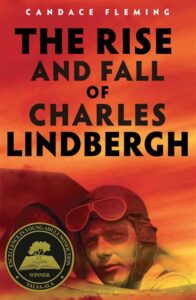 Candace Fleming’s “The Rise and Fall of Charles Lindbergh” is another title that exposes echoes between our past and present. I went into this book knowing just the basics about Charles Lindbergh…he was a celebrity American aviator whose baby got kidnapped. Fleming fills in all of Lindbergh’s messy details: a person who accomplished incredible mechanical feats for his time, while simultaneously allowing his obsession with eugenics to push him into racist beliefs that would lead to his public downfall. The book opens with a rowdy scene from one of the “America First” rallies Lindbergh headlined in the first half of the 20th century, and it was easy to imagine a similar scene unfolding today, close to one-hundred years later.
Teens, will you allow me a moment to get philosophical? I hope you said yes. These books got me thinking about a phrase from the preamble of our Constitution (you know how it is when you can’t get the preamble of the Constitution out of your head…I’m sure this is a very common phenomenon).
“…in order to form a more perfect Union…”
The delegates included the phrase “more perfect,” acknowledging in our most significant foundational document, that the Union was not, nor may ever be, perfect. How inspired and non-defensive it is to say “more perfect,” allowing room for self-reflection and flaws and evolution. It feels very patriotic to me to look critically at the past to discern a “more perfect” path forward. These books, that shine lights on some troubling times and complicated individuals from our past, remind me to feel deeply grateful you have the right to disagree.
 If this is something that also gives you shivers (a.k.a. you enjoy writing, thinking about ways to make your writing glint, and/or staring at broken glass), I have good news. We’re starting a teen writers’ club at A.K. Smiley Public Library in February and we would love for you to join us. What is the name of this club? I don’t know. What will we do at this club? I don’t know. Is it even a club? I don’t know. This is a brand-new club, and the beauty of brand-new clubs is they can be anything we want them to be. They can even NOT be a club!
 “
“ The YA titles below all feature characters who also experience anxiety in one form or another, and while the library does offer nonfiction and online resources with more instructional “how to deal” perspectives, these novels help in another way…they make you feel less alone.
 In Jennifer Dugan’s “
 “
“ While I didn’t expect these YA books to clarify any complicated policy arguments, I did hope to humanize the issue with stories about human beings, some real and some fictional, that would help me avoid seeing immigrants through a single, threatening lens. Even if you’re not old enough to vote in this election, you’re definitely old enough to think about important things, so I’m sharing my reading list if, like me, you’re interested a fuller perspective.
 In “
In “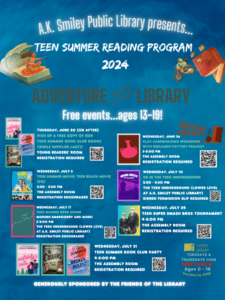 Teens, are you currently living out all your summer dreams? Are your hours filled with round-the-clock thrills and excitement? When school starts back up, will your classmates stare at you icily as you read aloud your autobiographical essay, “My Unbelievably Amazing Summer?” If you answered “yes” to any of these questions, put this article down immediately and get back to it! Congratulations! You’re excused to go on your unbelievably amazing way!
 Teens! I’ve got it! This is your ticket to an unbelievably amazing summer. Bring your curiosity and we’ll take care of the rest. For more information on what’s happening this summer (and beyond), visit our webpage at