Teens, I wanted to surprise you and spice things up this October by NOT writing about spooky, creepy, freaky Halloween-related books, but that required inspiration for a fresh theme. I typed “October Holidays” into my search bar, clicked a link, and rubbed my hands together when I saw the long list. This was going to be easy! “National Black Dog Day,” “CD Player Day,” “Virus Appreciation Day,” “National Transfer Money to Your Daughter Day” (I hope my parents are reading this), “I Love Yarn Day,” “National Hug a Drummer Day,” “Change a Light Day,” “International Day for Failure,” “Spreadsheet Day,” “World Egg Day”…all of these sacred holidays are celebrated in October! And this was only the tip of the iceberg. This article was going to write itself! It was time to head to the Young Adult (YA) shelves for my material…
 Long story short, I’m writing about witches.
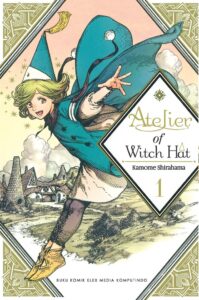
Kamome Shirahama’s YA manga graphic novel series “Witch Hat Atelier” is perfect if you love great illustration, action, and daydreaming about witchy shopping malls. When Coco accidentally unleashes dark magic by copying a seal from a mysterious book of spells, things quickly turn grim (translation: Coco messes up the world) and there’s no way she can undo this alone. Qifrey (a witch), takes Coco under his wing, where she will train at his atelier, along with a cast of other apprentice witches. Meanwhile, dark forces are working against Coco…which side will prevail? (No pun intended.)
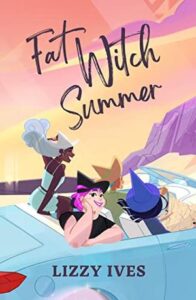 In Lizzie Ives’ YA novel “Fat Witch Summer,” Thrash is a plus-sized, acne-prone sixteen-year-old witch whose mother is the total opposite; her mom practically glitters with slim witchy perfection and power. After accidentally stumbling upon her own aptitude for magic, Thrash discovers she will receive a special, supernatural Gift: Glamour, Growth, or Sight.
The problem? Gifts are chosen by mothers, and Thrash fears her mom is going to select the Gift that will make Thrash her mom’s mirror image. But Thrash likes herself the way she is, and thus, she goes on the run, joining forces with a coven of teen witches, who are determined to steal their own Gifts and self-actualize the witches they want to be. After a wild and witchy road trip, which Gift will Thrash end up with? (Of course, again, no pun intended.)
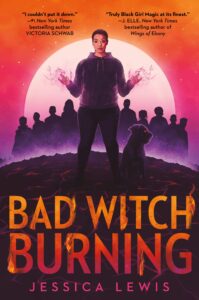 Katrell talks to dead people. In “Bad Witch Burning,” by Jessica Lewis, sixteen-year-old Katrell leverages her paranormal conversational powers to make money for her financially unstable family, but it’s never enough. When Katrell learns she can do more than just talk to the dead, things start getting serious. She realizes there is a lot more money to be made, but she receives a warning from the spirit world that she is treading into treacherous territory and needs to stop. Which voices will Katrell listen to? (Again, this word choice is purely coincidental).
Teens, I hope you will stop in to the library this October and read something witchy or anything else that casts a spell on you.
And, of course, I’m also wishing you the happiest and healthiest “World Egg Day.”
Kristina Naftzger is a Youth Services librarian at A.K. Smiley Public Library.
 Have you ever wondered what happens behind the scenes before a book makes its way into your hands, or onto your reading device?
 Next, we have a book that centers on the relationship between readers and reading.
 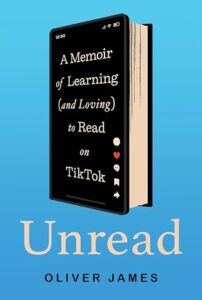 Finally, we have a memoir by Oliver James,
 Cozy Halloween Reads
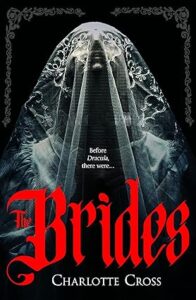 Scary Reads
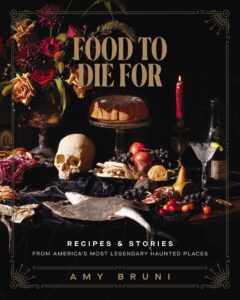 Non-fiction titles
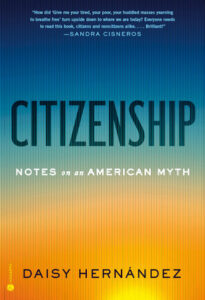 Hispanic Heritage Month is here, and at A.K. Smiley Public Library, we have plenty of new books for you to read by Latinos across the wide spectrum of genres.
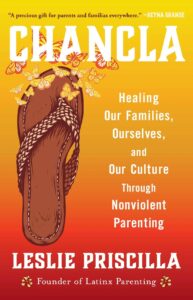 “
“ “
“ “
“ “
“ In the Youth Department, there’s never a shortage of fun programs and events going on. We’re busy all year ’round! September and October are especially chock-full of events, ranging from story times, to a teen art contest, to a cooking demonstration. Here I will highlight our programs for the fall.
 Book Buddies Club
 Now that we’ve covered our recurring events, there are a few one-day events in September and October to introduce. On Sunday, September 20, we will host a 90th Anniversary Celebration for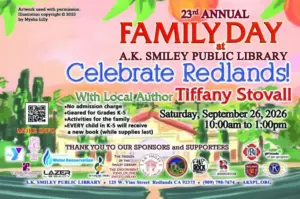
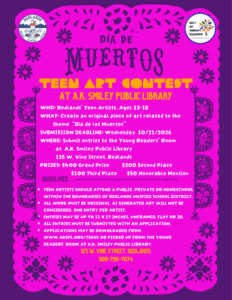 In addition to our events and programs for children, Smiley Library also has tons of things to do for teens, thanks to Miss Kristina. The