This week we mark the one-year anniversary of the first lockdown due to COVID-19. While this lockdown has had different impacts for different people, nevertheless it has affected us all. To foster understanding of how we all are coping through this time, here are some works that give their authors’ perspectives on the pandemic.
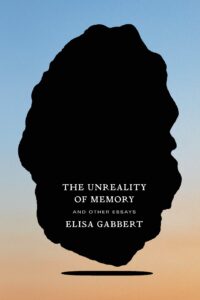 Written in the year preceding the outbreak of the novel coronavirus, in The Unreality of Memory: And other Essays, Elisa Gabbert touches on what came to be some of the most difficult aspects of quarantine, how a pandemic comes to be, and our own questions of existence. Gabbert touches on what causes pandemics and even Dr. Anthony Fauci gives us insight into our perceptions of vaccines. Gabbbert had inclinations on a worldwide event occurring soon as she writes about how we deal with natural disasters and how we react to them. While some may feel survivor’s guilt, others may feel survivor’s thrill, elation at being alive. The author even deals with our perceptions and memories by writing about how we curate and alter our memories as we are forming them. Compelling and sometime frightening, Gabbert’s work gives us insight into just how we got to where we are.
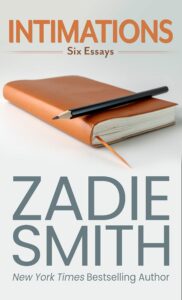 Zadie Smith deals with growing feelings of disconnect that arise from quarantine in her latest book of essays entitled Intimations: Six Essays. Written as lockdown was at its beginning, Smith looks at her own luck in being able to leave New York just as the worst was about to hit. She acknowledges her own privilege and how it has played such a part in who has made it through the pandemic and who has not. Smith, however, does not downplay how suffering touches us all. Suffering is not mitigated by privilege, in her words; it is absolute. She discusses how her relations with her neighbors change so drastically and how it went from a community united to one merely trying to survive. Smith also writes how so many of us have the need to accomplish tasks in order to fill time, and that this inclination to be productive arises from our desire to make life meaningful. Smith’s work gives a chance to view through another’s insightful lens during this trying time.
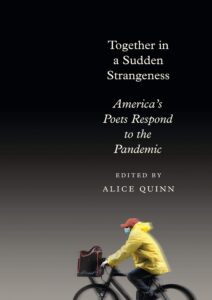 Together in a Sudden Strangeness: America’s Poets Respond to the Pandemic takes a different approach. Edited by Alice Quinn, the work is an anthology of poems written by different poets during the pandemic. Each poet experiences life differently, from those who can work from home without issues, to those who work in the medical field and are facing the illness head on. The works are all vulnerable and whether from famous authors such as Sharon Olds or Jericho Brown, or form those we have not had the pleasure of meeting in the literary sense, all are poignant. Many writers focus on details that would seem so minute, like saving an ant or being able to hand a loved one a cascarón, but in this present time seem to epitomize our feeling of helplessness. There is also hope, hope to see a loved one again, or visit a hometown. It is through this hope that this volume of poems finds its strongest message.
As we all hope for this pandemic’s eventual end, let’s continue to stay safe and enjoy some new perspectives on this trying time.
 “
“ “
“ “
“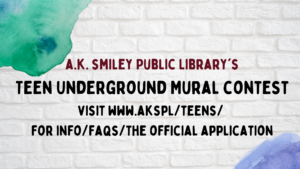 Teens, we interrupt our regularly scheduled book recommending to bring you some exciting news. While A.K. Smiley Public Library has been closed to in-person visits, we’ve been busy behind the scenes giving the Teen Underground space a mini-makeover…new paint, a little reorganization, some new signs: a subtle revamp we hope will make it easier to find things and easier on your eyes when we reopen on March 8. While things are definitely looking fresher, we quickly realized something was still missing. Something that could make the space feel energetic and vibrant. YOU.
 Pop/Rock: “
 Rap: “
 Folk/Country: “
 Jazz: “
 Classical: “
 “
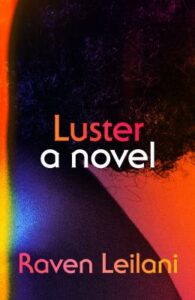
“ If one is looking for something on the lighter side to read, “