 Mother’s Day announces its arrival all throughout diners, flower shops, and T.V. ads each year in May. A day dedicated to one of the most complex, rewarding, and difficult challenges anyone can take on. One wonders if perhaps one day is truly enough to encompass the role that weighs heavy on mothers. In many countries more and more women are choosing not to have children, or to hold off on the plan, eliciting concerns about population decline and future workforces. But what about some consideration for motherhood outside of its benefits to societal capital? Here are three new books that offer but a small glimpse into motherhood, beautiful, warm, loving, and complicated motherhood.
“The Waterbearers: a Memoir of Mothers and Daughters” by Sasha Bonét weaves a story of the daughters, the mothers, the women, and the inseparable tie that motherhood played in generations of Bonét’s family. Her writing is fluid, carrying you on a lazy river through the intrepid stories of the women who shaped her and generations before her. Bonét makes use of bodies of water, rivers, tributaries, and oceans as metaphors for the women’s influence on each other. Even as they move further from the main river, they remain connected, at times beyond their own comprehension, to the river that feeds their tributaries and the river to the ocean where it finds its source.
This book is about motherhood, but more than that it’s about black motherhood. What it means to carry generations of trauma rooted in racism, misogyny, and everything in between. Bonét lets others into this intimate world of women and girls, of mothers and daughters. This world is cold and warm; family is home and the thing that pushes you to search for escape. Tender. Painfully so. You may well be left thinking back to the shared sit-downs of your family; the children running and screaming while the women prepared dinner. There is a certain amount of self-reflection that Bonét’s writing prompts. If you are a woman or were raised as one it holds a torch to the caves of womanhood. Women are complicated. Mothers are good and bad, loving and scary. These imperfect beings shape the future generations all while trying to be people themselves. The writing is easy to follow, the stories are hard to look away from, and this one is a must-read.
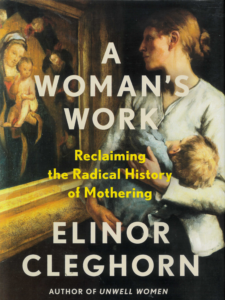 Zooming out from one family history to a broader history we find Elinor Cleghorn’s “A Woman’s Work: Reclaiming the Radical History of Mothering.” Cleghorn does not pull her punches as she rips into the dense and forgotten history of motherhood, pregnancy, midwifery, and adjacent topics from the people who experienced it in history. Women’s slow crawl from objects of patriarchal structures to the growing personal rights of women and the continued struggles for choice and autonomy today. It is honest, and uncomfortable at times as it forces the reader to re-evaluate how you view motherhood, even if one does not agree with every point Cleghorn makes. Many people don’t bother learning about the experiences of pregnant people, until they themselves experience it as an expectant parent. What is pregnancy really like? Surely, it’s more than just the morning sickness and swollen soles commonly depicted in media. History so often written by men details wars, laws, and yet how often do we search for the words, the traces of the women and mothers who reared the past and present, the leaders of today and tomorrow. The book can become dense in the fog of history at times but offers impactful and important insights into women’s experiences in history. A thought-provoking review of what it has meant to become a mother throughout time.
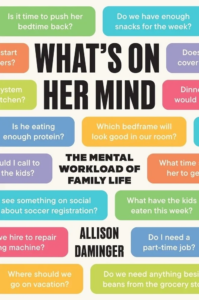 For a look at modern motherhood, “What’s on Her Mind?” by Allison Daminger looks at the seldom considered invisible mental workload of women in the modern family setting. While rising numbers of men and partners continue to grow their equal share of physical tasks and labor to take on in the household, inequity still clearly exists in about every family Daminger has spoken to and interviewed in the many years she has dedicated to this topic. She explores the mental work load, sometimes unintentionally, dumped on mothers, what she calls “Cognitive Labor.” Daminger found that even in relationships where physical labor and chores are split equally between partners, women’s share of cognitive labor, that is the mental load of stress, of anticipating future plans, family needs, and more, is considerably heavier than that of men. Lopsided distribution of cognitive labor brings helpful insight for couples and families who may be looking to make the family workload equally distributed and dissipate tension that can be hard to explain. An eye-opening account into cognitive labor and how these things burden women far more than men, it’s one more thing to add to the weight that mothers carry on their backs.
Please feel free to check out all these and much more in the new section at A.K. Smiley Public Library. Happy Mother’s Day to all the mothers out there and all others who celebrate it!
Ruth Aguilar is a library specialist at A.K. Smiley Library who is not a mother but has one.