“From a small spark kindled in America, a flame has arisen not to be extinguished.” — Thomas Paine
 This year on the Fourth of July, we will celebrate the 250th anniversary of the Second Continental Congress adopting the Declaration of Independence and its powerful line:
“We hold these truths to be self-evident, that all men are created equal, that they are endowed by their Creator with certain unalienable Rights, that among these are Life, Liberty, and the pursuit of Happiness.”
If you are in need of some fresh historical perspective on our founding, and maybe a bit of a democracy-booster, try perusing these newer books at Smiley Library marking the anniversary.
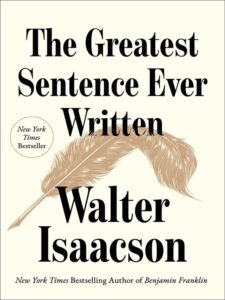
Bestselling biographer Walter Isaacson describes the heralded statement as America’s mission statement, with the title of his latest work, “The Greatest Sentence Ever Written.” Within his word-by-word analysis he surmises how the sentence, revolutionary for its time, could, and should, now shape our polarized politics of today. Kirkus Reviews observes that Isaacson’s book is, “A short, smart analysis of perhaps the most famous passage in American history reveal(ing) its potency and unfulfilled promise.”
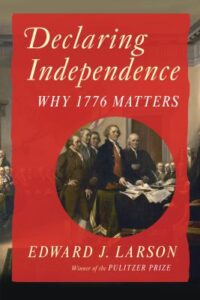 Historian and legal scholar Edward J. Larson chronicles the events of the year encompassing the document in “Declaring Independence: Why 1776 Matters.” As the year begins, most colonists show little interest in national independence, but by the end, the need becomes undeniable. In between the introduction early in 1776 of the ideals Thomas Paine puts forth in his pamphlet, “Common Sense,” to the new American army’s hard-won victory at Trenton at year’s end, the Declaration of Independence becomes the standard to which we swear to adhere, though we seemingly are not yet mature enough to embrace all of Paine’s teachings, or to recognize the irony present in the Declaration’s words. It was not yet evident for swaths of colonial populations: indigenous, African, and others, as well as women, that the word, “all,” was a misnomer: all were not yet included in the soon-to-be new American standard of equality.
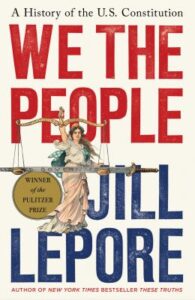 Fortunately, though, and intentionally, we followed our Declaration with the living, amendable document of our Constitution, allowing for blind spots like these to be righted, and allowing for change without violence. In “We the People: A History of the U.S. Constitution,” historian Jill Lepore reminds us that for the last 80 years or so the use of the amendment has become slogged. She says we are still adjusting our system, but lately only via judicial decisions that are influenced by a select few elites in government and industry, endangering the civility of our process. She believes the framers expected that “future generations would be forever tinkering with it, hoping to mend America by amending its Constitution through an orderly deliberative and democratic process.”
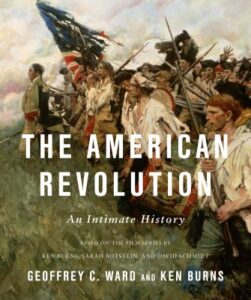 Finally, the dichotomies move closer together with “The American Revolution: An Intimate History” by Geoffrey C. Ward, in collaboration with documentary filmmaker Ken Burns, who tells our founding story by revealing it not from the top down but from the bottom up–through the eyes of those of ordinary soldiers and underrepresented populations. As Burns puts it, ‘the revolution is often seen “in gallant, bloodless terms,” whereas the achievement of this volume is to be forthright and occasionally critical, but still grand and stirring.’
Here’s to an America of 250 more years always striving toward that more perfect union.