“You’re standing on a planet with molten lava in the middle. Your heart is beating without you asking. There’s a moon in the sky and bugs that glow. This whole thing is absurdly beautiful — don’t forget to notice.” ~ Jasmine Wilder, thetinyjoyproject, Instagram
 Mark your calendars, friends: April 22 is Earth Day, and your assignment is to notice — to go outside, take a deep breath, and hug a tree that is deeply and wondrously rooted in this spinning rock of ours.
While you’re out, you might as well stop by and see us at Smiley Library, perhaps sometime this week, National Library Week, or its culmination next Saturday, April 25, for Smiley Library’s annual Library Days celebration from 10 a.m. to 2 p.m.
The theme of Library Days this year is “Find Your Joy,” so we invite you to come in and look for something that may bring you joy — like an earth-inspired item! Whether about a tree, a flower, a river or a rock, or just one of us creatures, there is, naturally — ‘nature-ally’ — something for everyone at the library!
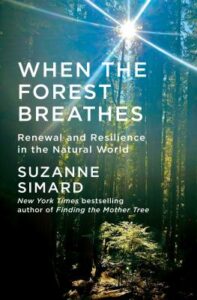
I love the cover photo of our first featured book — just looking at it brings a relaxing sigh . . . “When the Forest Breathes: Renewal and Resilience in the Natural World.” Author Suzanne Simard, a professor of Forest Ecology at the University of British Columbia, has crafted both a memoir and an account of the implementation of her Mother Tree Project, a campaign of forest ecology research conducted across multiple sites in Canada. Simard reflects on the importance of honoring the ebb and flow of human life cycles within her own family, such as the coming-of-age of her daughter and the end of life of her mother, and weaves this theme in with the natural life cycle of forests.
 Simard stresses that preserving forests’ natural cycles of death and renewal is key to their longevity. Of vital importance to the Earth’s fragile ecosystems, forests continue to be disrupted by industrial logging companies, which harvest trees by clear-cutting, a technique, that Simard iterates, releases greenhouse gases into the atmosphere, destroys wildlife habitats, and increases the risk of wildfires and floods.
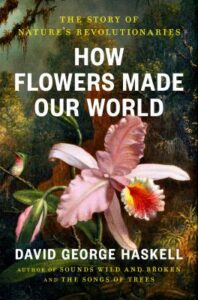
This next book fascinates me, “How Flowers Made Our World: The Story of Nature’s Revolutionaries” by biologist David George Haskell. The floral world is “late-blooming,” so to speak, in the history of the evolution of Earth, having done so after many complex animals in the fossil record some 150–200 million years ago. Quickly diversifying, plants became “champion relationship-builders,” as insects, birds, and other animals came to rely on them for food and shelter. The flexibility of plant genetics is vital to us too! They enabled the development of important crops that supported agrarian civilizations, like wheat, oats, potato, and cotton. Now that’s Flower Power!
We also highly recommend these additional works:
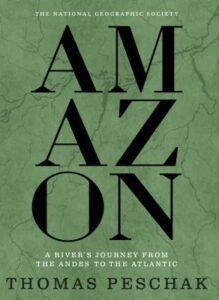 “Amazon: A River’s Journey from the Andes to the Atlantic” by Thomas P. Peschak
The rich photography here traces National Geographic explorer Peschak’s unprecedented expedition of the world’s greatest river: the Amazon. A web of more than 1,000 streams and tributaries collectively spawning an enormous water world larger than the continental United States, it is home to thousands of species of fish, aquatic reptiles, mammals, and birds–most found nowhere else on Earth.
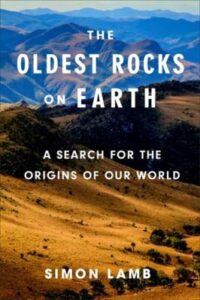
“The Oldest Rocks on Earth: A Search for the Origins of our World” by Simon Lamb
Geologist Lamb’s research in remote southern Africa looks at some of the oldest known rocks — some more than 3.5 billion years old, unearthing a violent world of natural disasters and climate change in the deep ocean, along ancient shorelines, and amid rising mountains. In so doing, he shows how geologists work and think, and how they read rocks and decipher what they tell us of the past, and the future.
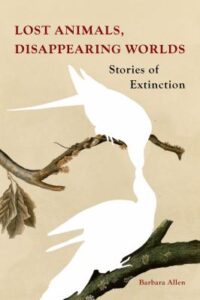
“Lost Animals, Disappearing Worlds: Stories of Extinction” by Barbara Allen
This book presents thirty-one extinct species through personal portraits to say, we see that you have been here — we notice. The intimate approach not only highlights each particular species but also explores the profound, broader implications of losing a species forever.
P.S. For an extensive list of books on Earth care for adults, teens, and children, please visit out 2024 blog post, Celebrate Earth Day every day.
Teresa Letizia is a photo-documented tree-hugger, as well as a library specialist at A.K. Smiley Public Library, 125 W. Vine St., Redlands.